Top Sustainable Siding in America: The Definitive Editorial Guide
The American residential landscape is currently undergoing a profound revaluation of its material boundaries. For much of the twentieth century, the exterior cladding of a home was viewed primarily through the dual lenses of cost-efficiency and immediate aesthetic appeal, often at the expense of environmental health and long-term structural integrity. Top Sustainable Siding in America. Today, however, the discourse has shifted. The building envelope is no longer seen as a static shield but as a dynamic participant in a broader ecological cycle—one that encompasses carbon sequestration, resource circularity, and the health of the interior living space.
Navigating the transition toward high-performance, low-impact housing requires a departure from the “maintenance-free” marketing narratives that dominated the era of fossil-fuel-based synthetics. True sustainability in cladding is not a singular product attribute; it is a calculation of a material’s lifecycle, from the energy required for its extraction and manufacture to its eventual decommissioning or reintegration into the biosphere. In a market saturated with “greenwashed” claims, the challenge for the modern developer or homeowner is to identify materials that offer genuine ecological restorative potential without compromising the fundamental requirement of moisture protection.
This exploration aims to deconstruct the technical and ethical variables that define the premier tier of building skins in the United States. By moving beyond surface-level metrics, we will examine how the chemistry of substrates and the physics of the wall assembly contribute to a home’s overall environmental footprint.
Understanding “Top Sustainable Siding in America”
Defining the top sustainable siding in america requires a multi-perspective analysis that transcends simple recycling labels. To some, sustainability is measured by “Embodied Carbon”—the total greenhouse gas emissions generated before the material even arrives at the job site. To others, it is a question of “Operational Efficiency,” specifically how a siding system contributes to the R-value of the wall and reduces the building’s lifetime heating and cooling demands. A truly flagship material must excel across both these metrics while maintaining high “Circular Potential,” meaning it can be safely returned to the earth or reused at the end of its functional life.
Oversimplification in this field is a significant risk, particularly regarding the lifespan of a material. A “green” material that fails after fifteen years due to poor moisture management is fundamentally less sustainable than a more carbon-intensive material that lasts for a century. This is the “Durability Paradox”: ecological impact is a function of time.
Furthermore, regionality plays a decisive role in sustainability. A siding material sourced from a forest in Oregon may be highly sustainable for a project in Seattle, but the carbon footprint associated with shipping that same timber to New Jersey may negate its ecological benefits. A multi-perspective view necessitates an “ecomodernist” approach: selecting materials that are appropriate for the local climate, available through regional supply chains, and capable of withstanding local environmental stressors like high humidity, salt spray, or wildfire risks.
Historical and Systemic Evolution of the American Facade
The trajectory of American siding has moved from “Vernacular Bio-materials” to “Petrochemical Dependency,” and now toward “Engineered Circularity.” In the pre-industrial era, homes were clad in what was available: local timber, stone, or clay. These materials were inherently sustainable because they were minimally processed and biologically compatible with their surroundings. However, they required high levels of maintenance to prevent rot.
The mid-twentieth century introduced vinyl (PVC) and aluminum, which were marketed as “permanent” and “maintenance-free.” This period represented the peak of the linear economy—extracting oil or ore, manufacturing a product with high embodied energy, and eventually sending it to a landfill where it would persist for centuries.
Conceptual Frameworks for Ecological Evaluation
To evaluate siding through a senior editorial lens, one must apply these three mental models:
-
The Carbon Sequestration Framework: This model prioritizes bio-based materials (like timber or cork) that actively pull $CO_2$ from the atmosphere during their growth phase, effectively turning the house into a carbon sink.
-
The Cradle-to-Cradle (C2C) Model: This framework assesses whether a material is a “biological nutrient” (can biodegrade) or a “technical nutrient” (can be infinitely recycled). Materials that fall into neither category—like most mixed-media composites—are viewed as lower-tier.
-
The Thermal Bridge Index: This evaluates the siding not as a standalone product, but as part of an insulated assembly. Sustainability is measured by how effectively the siding system allows for continuous exterior insulation to break thermal bridges.
Key Categories of Regenerative and Low-Impact Materials
The current market for high-performance skins is dominated by a few specific material classes that balance ethics with engineering.
Comparison of Sustainable Cladding Assemblies
| Material Class | Primary Benefit | Carbon Profile | Expected Lifespan | Primary Trade-off |
| Thermally Modified Timber | Rot resistance without chemicals | Carbon Negative | 40–60 Years | High initial cost |
| Fiber Cement (Low-Carbon) | Fireproof and durable | Carbon Neutral (offset) | 50+ Years | Heavy to transport |
| Reclaimed Wood | Zero new resource extraction | Carbon Negative | 30–50 Years | Limited supply/variability |
| Natural Stone Rainscreen | Extreme longevity | Low Embodied Energy | 100+ Years | Intense labor/Structural load |
| Pultruded Fiberglass | Inert and recyclable | Moderate | 70+ Years | Not biodegradable |
| Cork Cladding | High insulation value | Carbon Negative | 50+ Years | Unique aesthetic/Cost |
Realistic decision logic: For a project prioritizing fire safety in the Western US, low-carbon fiber cement or stone is the logical flagship choice. For an East Coast project focused on carbon neutrality, thermally modified wood—which uses heat instead of toxic preservatives to achieve durability—represents the pinnacle of the niche.
Detailed Real-World Scenarios Top Sustainable Siding in America
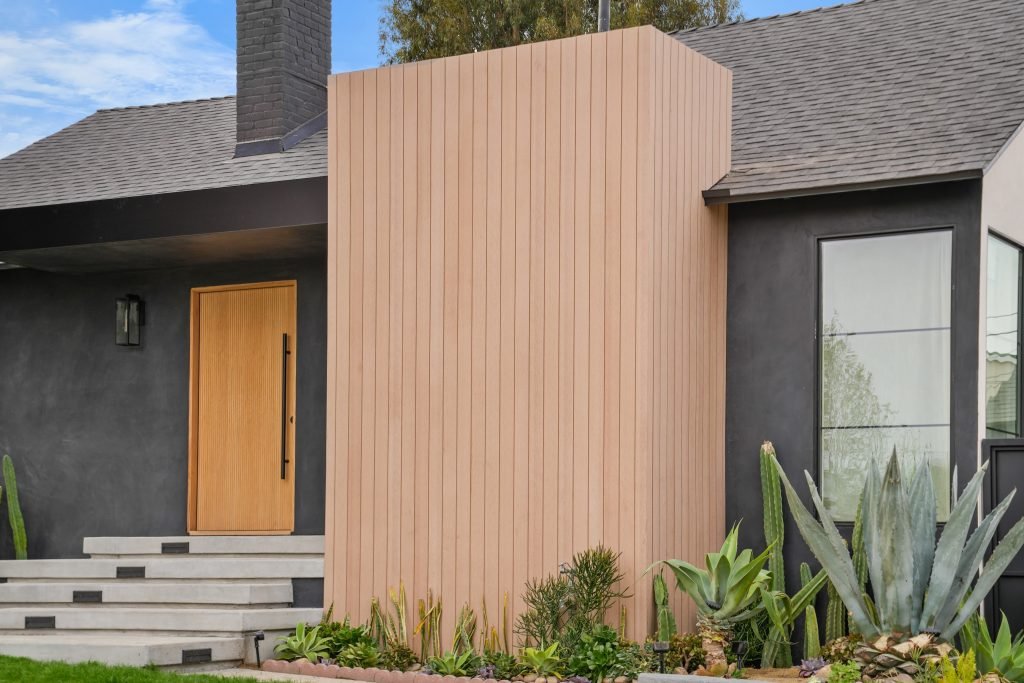
Scenario 1: The Wildfire-Urban Interface (WUI)
In states like California or Colorado, sustainability is inextricably linked to resilience. A “green” cedar home that burns down in a decade is an ecological failure. In these scenarios, the top sustainable siding in america is often a mineral-based system, such as lime-plaster or autoclaved fiber cement, which offers a Class A fire rating while utilizing recycled fly ash or volcanic glass in its matrix.
Scenario 2: The Coastal Salt-Spray Zone
In coastal South Carolina or Maine, the primary threat is salt-induced corrosion and high humidity. Traditional wood requires frequent repainting—a process that introduces microplastics and VOCs (Volatile Organic Compounds) into the local ecosystem. A sustainable alternative here is a natural stone rainscreen or a high-performance mineral panel that requires no coating, thus eliminating the chemical maintenance cycle for the life of the building.
Planning, Cost, and Resource Dynamics
The “Green Premium” is a frequent point of discussion, but an editorial analysis reveals that sustainable siding often has a lower “Total Cost of Ownership” (TCO).
Investment Profile for Sustainable Envelopes
| System Type | Upfront Premium | Maintenance Cycle | 30-Year TCO |
| Standard Vinyl | 0% (Baseline) | Replace at Year 15 | High (due to replacement) |
| Modified Timber | +30–50% | Oil every 5 years (optional) | Moderate |
| Natural Stone | +100% | None | Low |
| Fiberglass | +40% | None | Low |
Opportunity cost: Choosing a non-sustainable material often locks the owner into a “Maintenance Debt.” The money saved upfront is eventually spent on specialized cleaners, repainting, or premature replacement as the material degrades under UV exposure.
Support Systems and Strategic Technical Integration
A sustainable exterior is only as effective as the “hidden” systems behind it.
-
Vented Rainscreens: A 1/4″ to 3/4″ air gap that allows moisture to drain and the wall to dry, doubling the lifespan of the siding.
-
Mineral Wool Insulation: Unlike spray foam, mineral wool is made from rock slag, is highly breathable, and offers superior fire resistance without the use of blowing agents with high global warming potential.
-
Stainless Steel Fasteners: Ensuring the siding doesn’t fall off due to fastener corrosion—a common cause of premature siding “death.”
-
Smart Vapor Retarders: Membranes that change their permeability based on the humidity, protecting the structural frame from mold.
Risk Landscape and Compounding Failure Modes
The “Taxonomy of Failure” in sustainable siding often stems from “Incompatible Integration.”
-
The “Trapped Vapor” Risk: Using a highly sustainable but non-breathable siding (like certain metals) without a proper air gap, which causes the wood frame to rot from the inside out.
-
The “Green-Wash” Trap: Buying a material that is “90% recycled” but bound together with formaldehyde-based glues that off-gas into the environment.
-
Fastener Incompatibility: Using galvanized nails with thermally modified wood; the high acidity of the wood can eat through the nails, causing the siding to sag.
Governance, Maintenance, and Long-Term Adaptation
Sustainability requires a “Governance” mindset—treating the home as a long-term asset that requires periodic, low-impact check-ups.
-
The Annual Intake Audit: Ensuring the bug screens at the bottom of the rainscreen are clear of debris to maintain airflow.
-
UV Monitoring: On south-facing walls, observing the silvering of natural woods; deciding whether to embrace the patina or apply a plant-based oil.
-
Sealant Integrity: Inspecting bio-based caulks or gaskets every 5 years to ensure the airtightness of the envelope remains intact.
Measurement, Tracking, and Evaluation
How do we prove a siding system is “Top-Tier”?
-
Leading Indicator: The “Embodied Carbon Coefficient” (measured in $kg CO_2e/m^2$).
-
Lagging Indicator: The “Replacement Interval”—how many decades the system lasts without structural intervention.
-
Qualitative Signal: The “Health Transparency” of the material, often verified through Health Product Declarations (HPDs) or Declare labels.
Common Misconceptions and Oversimplifications
-
“Recycled is always better”: A recycled plastic siding that cannot be recycled again at the end of its life is a “down-cycled” product, not a circular one.
-
“Wood is a Fire Hazard”: Modern mass-timber and thermally modified woods have surprisingly predictable char rates and can be safer in a fire than thin-gauge metals that melt and deform.
-
“Sustainable means Expensive”: Many sustainable practices, such as choosing a local, minimally processed stone, can be competitive with high-end imported synthetics.
-
“Maintenance-free is the Goal”: Every material requires some care. A material that claims to need “zero” care is usually one that cannot be repaired once it eventually fails.
Ethical and Contextual Considerations
The ethics of siding extend to the labor involved in its extraction. “Sustainable” stone sourced from a quarry with poor safety standards or “sustainable” timber from an uncertified forest in a developing nation carries a heavy social cost. In America, the highest level of sustainability involves sourcing from FSC-certified (Forest Stewardship Council) forests or quarries that participate in land reclamation programs.
Conclusion
The selection of a home’s exterior is a profound statement on the owner’s relationship with the future. The top sustainable siding in america is characterized by its ability to protect the structure while simultaneously healing the environment—whether through carbon sequestration, the elimination of toxins, or the preservation of finite resources. As building codes evolve to meet the challenges of the climate crisis, the “standard” of the future will be defined by materials that are as resilient as they are responsible. A flagship building skin is no longer just a barrier; it is a legacy.